
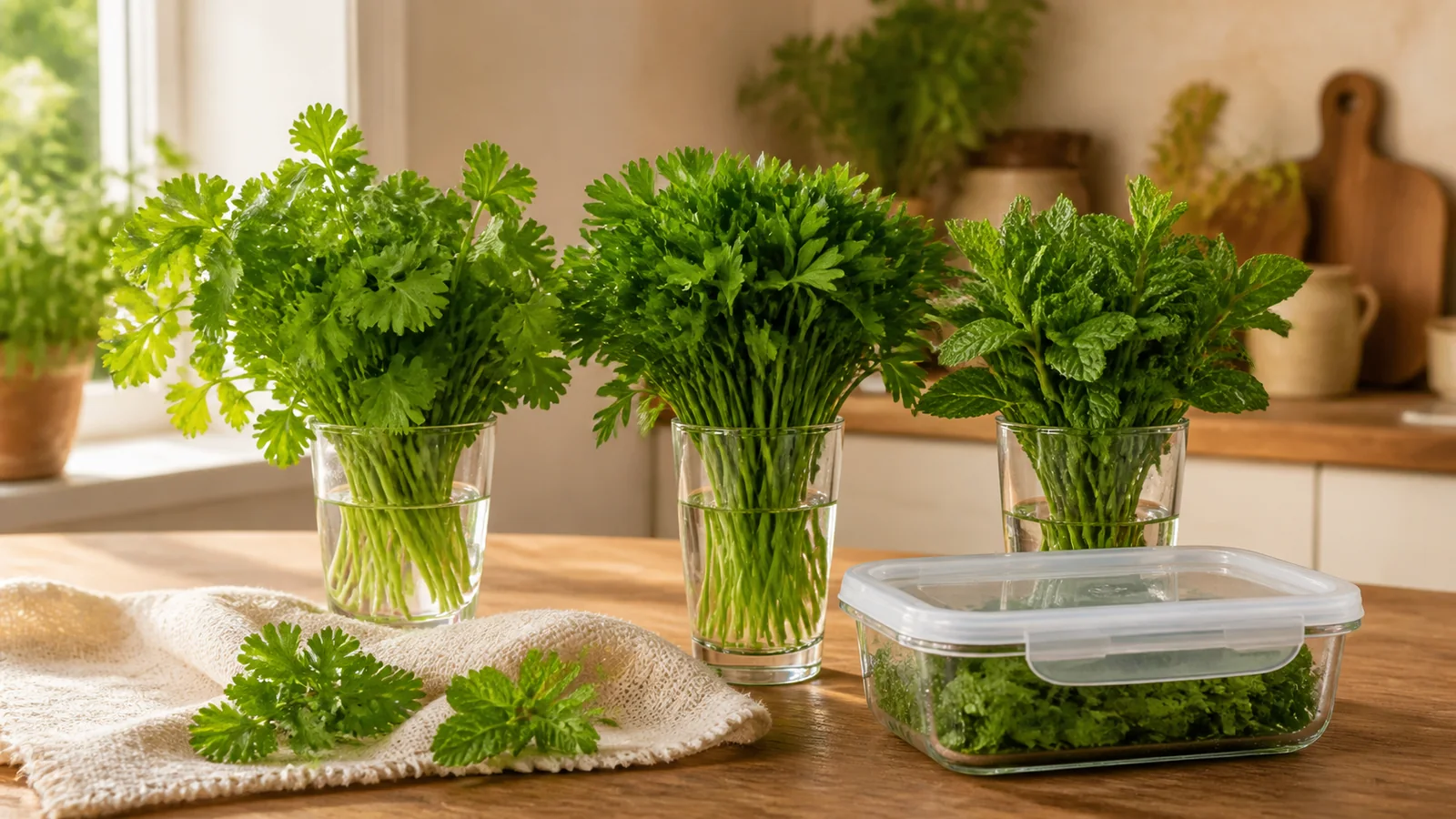
Buying a bunch of coriander on Saturday and finding it black on Monday is one of the most common frustrations in a Portuguese kitchen. The good news is that the problem isn’t the coriander: it’s the way it’s stored.
Coriander, parsley and mint are some of the most used herbs in Portuguese cuisine: from tomato rice to caldo verde: but they are also the ones that spoil the fastest. This guide brings together three preservation methods, how long each can last and the most common mistakes that accelerate spoilage.
Why does coriander turn black
Darkening occurs through a combination of oxidation and trapped moisture. When the bunch comes from the supermarket in a tight plastic bag, the condensation that forms inside the bag keeps the leaves moist without air circulation: and it is this stagnant humidity, more than the cold, that accelerates decomposition. Drying the leaves well before storing is the step that most influences the duration.

Method 1: Bottle of water (which lasts longer)
It’s the most effective method for coriander and parsley, and the closest to treating the herb like a bunch of flowers:
- Quickly wash off the bunch and dry well with kitchen paper or a cloth.
- Cut off about 1 cm from the base of the stems.
- Place in a jar with 3-4 cm of water at the bottom, like a cut flower.
- Cover the top with a wide plastic bag, loosely.
- Store in the refrigerator, in the coldest part (not on the door).
- Change the water every 2 days.
Done this way, coriander and parsley usually keep fresh and green for about two weeks.
Method 2: Damp kitchen paper
Quicker to prepare, but shorter in duration. Wrap the dried herb in slightly damp (not dripping) kitchen paper and store it in an airtight container in the refrigerator. It is a good option for small quantities that will be used during the week.

Method 3: Freezing in olive oil cubes
For those who won’t use the fresh herb in time, freezing avoids waste completely. Chop the herb, mix with a little olive oil and distribute over an ice cube tray. Once frozen, the cubes are placed in a bag and are ready to be added directly to stews and soups: without needing to defrost first.
How long does each method last
- Coriander, bottle of water: up to 14 days.
- Parsley, bottle of water: it usually lasts a little longer, around 16 days, as it has more resistant stems.
- Mint, bottle of water: about 12 days.
- Damp paper (the three herbs): between 4 and 6 days.
- Freezing in olive oil cubes: several months, without significant loss of flavour in sautéed dishes.
Mistakes that accelerate spoilage
- Storing the herb next to fruit that releases ethylene gas (such as apples or bananas): it accelerates yellowing.
- Washing in warm water instead of cold water.
- Storing basil in the fridge: unlike coriander, basil doesn’t like the cold and darkens faster inside than at room temperature.